


What is Keras?
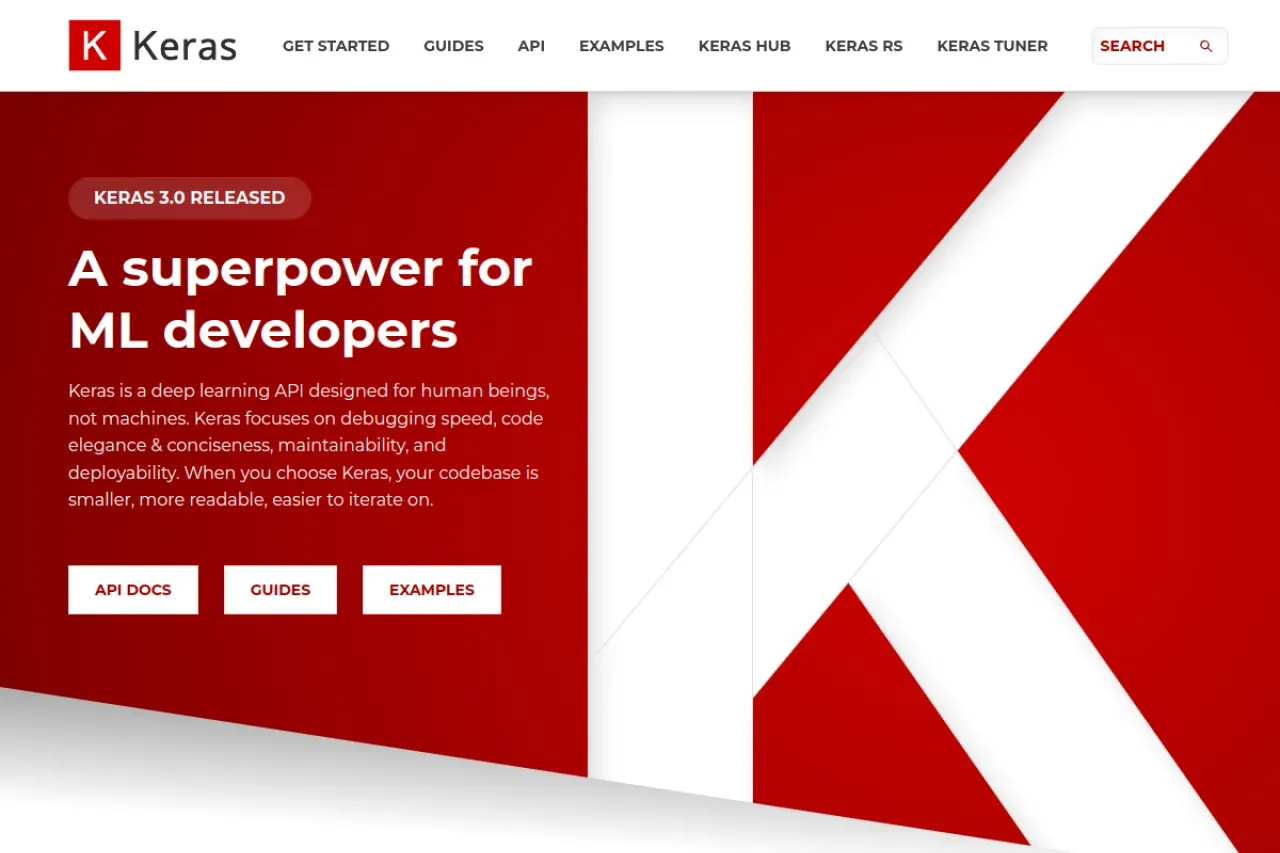
Keras is an open-source deep learning library known as “Deep Learning for humans.” It provides a simple, elegant, and highly abstracted interface for building neural networks, dramatically speeding up model development and debugging.
Key Features
The main innovation of Keras 3 is its multi-backend approach. The same code can run on JAX, TensorFlow, or PyTorch. This gives developers the freedom to choose the most suitable framework for each task without rewriting the model.
The library includes a convenient Functional API, makes it easy to build complex architectures (including Residual connections), visualize models with keras.utils.plot_model, and train them quickly using model.fit().
KerasHub and Pretrained Models
KerasHub provides access to pretrained models. The website examples show loading Gemma 2 for code generation from a text prompt and Stable Diffusion 3 Medium for text-to-image generation (“Astronaut in a jungle, detailed”).
Additional Tools
The ecosystem includes KerasTuner for automatic hyperparameter tuning, KerasRS, and extensive documentation for both Keras 2 and Keras 3. The library focuses on development speed, code readability, maintainability, and easy deployment.
Who is Keras for?
Keras is perfect for researchers, students, and practicing engineers. It significantly reduces boilerplate code, allowing focus on model architecture rather than low-level details. Thanks to multi-backend compatibility, models created in Keras integrate easily into existing TensorFlow, PyTorch, or JAX ecosystems.
The library is completely free, open-source, and actively developed. It remains one of the most popular tools for deep learning due to its balance of simplicity and power.