Apple has spent years trying to make Siri a truly smart assistant, but in recent years the voice assistant has increasingly looked stuck somewhere between quick commands and simple answers from the internet. Compared with ChatGPT, Gemini, Claude and other AI services, Siri no longer looked like an assistant of the future, but rather a convenient yet limited feature inside the iPhone.
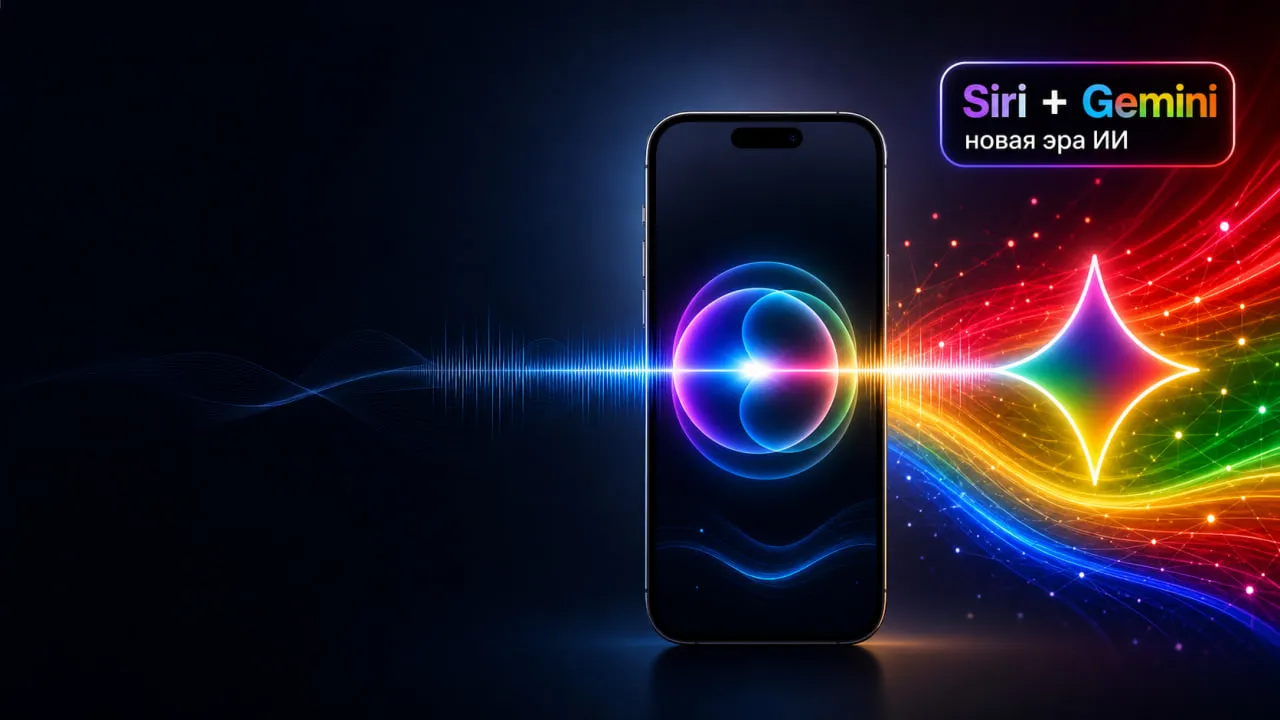
Now the situation is changing. Apple has officially confirmed that the new version of Siri will use Google Gemini technology. For the artificial intelligence market, this is an important moment: one of the most closed technology giants is effectively admitting that it needs a strong external partner to move faster in AI.
What happened
Apple chose Google Gemini as the foundation for part of Siri’s and Apple Intelligence’s new intelligent capabilities. This does not mean that Gemini will simply replace Siri on the iPhone. Users will still talk to the familiar Apple assistant, but a more powerful language model will stand behind some complex requests.
In simple terms, Siri should become more than a voice button for alarms, weather and calls. The new version is expected to communicate more naturally, understand context, work with the user’s personal data and perform complex actions inside the Apple ecosystem.
If Siri previously struggled with questions that required analysis, summarization, logic or connections between different apps, Gemini may cover exactly that weakness.
Why Apple went to Google
At first glance, an Apple and Google alliance looks strange. The companies compete in smartphones, operating systems, browsers, services and advertising. But the AI race follows a different logic: speed, model quality and the ability to embed technology into a product for hundreds of millions of users matter more.
Apple has a strong ecosystem, control over devices, privacy, hardware and a loyal audience. Google has powerful AI models, deep experience in search, language processing, multimodal systems and cloud infrastructure. In this combination, Apple can quickly strengthen Siri, while Google can anchor Gemini inside one of the world’s most valuable user ecosystems.
For Apple, this is also a way to reduce the gap. While competitors actively developed AI assistants, Siri remained too cautious and limited. Apple’s own Apple Intelligence model did not cover all tasks at the level of market leaders, so the partnership with Google looks pragmatic.
How Siri may change
The main expectation is that Siri will understand the user better. Not just one phrase, but the whole situation: what the person was doing before, which apps they use, what data exists on the device and what result is needed.
For example, the new Siri may be able to:
find information in messages, mail, calendar and notes;
explain complex topics in simple language;
help write and edit texts;
perform chains of actions across apps;
better understand conversational speech;
answer with context, not like a separate search query.
The most important point is not that Siri becomes “another chatbot.” If Apple does everything right, the updated assistant will be useful specifically inside the iPhone: in messages, photos, reminders, documents, calls, routes and everyday scenarios.
Will Siri remain an Apple product
Yes, and this is key. Gemini will work as a technology engine, but the user experience will remain under Apple’s control. Apple is not interested in making Siri feel like someone else’s service inside the iPhone.
Most likely, Apple will emphasize three things: privacy, system integration and a familiar interface. The user will not need to think about which model answers the request. They will simply tell Siri what needs to be done.
This differs from using Gemini or ChatGPT through a separate app. There, the user opens a service and types a prompt. In Siri’s case, AI should be built much deeper: not as a separate website or chat, but as part of the operating system.
What about privacy
The privacy question is unavoidable. Apple has spent years building the image of a company that protects user data. That is why integration with a Google model immediately raises doubts: will Siri send too much information to an external partner?
Judging by Apple’s approach to Apple Intelligence, the company will try to keep as much processing as possible on-device or inside its own protected cloud infrastructure. For users, this means Apple will try to preserve control over what data is processed and how it is used.
But it is important to understand that the smarter an assistant becomes, the more context it needs. To truly help, Siri will have to understand mail, files, calendar, photos, messages and user actions. Apple’s main challenge is to make AI useful without creating the feeling of constant surveillance.
Why this matters for the whole AI market
Gemini’s integration into Siri shows that the AI market is entering a new stage. Separate chatbots are no longer the only important product. Embedded assistants that live inside devices and services are becoming just as important.
For regular users, this may be the moment when artificial intelligence stops being a separate browser tab. It will appear where people already perform familiar actions: writing a message, finding a file, building a route, understanding an email, preparing a note or quickly summarizing a document.
For Google, this strengthens Gemini. For Apple, it is an attempt to return Siri to the status of one of the main digital assistants. For competitors, it is a signal that the AI battle will happen not only in apps, but also at the operating system level.
Are there risks
Yes, and they are serious. First, Apple risks becoming dependent on external AI technology. The company has always liked to control key parts of its products, but here an important part of Siri’s intelligence will be connected to Google.
Second, users may react ambiguously. Some will be happy that Siri is finally becoming smarter. Others will ask a logical question: why could Apple, with all its resources, not build such AI on its own?
Third, success depends not only on Gemini’s power. Integration matters. Even a strong model can feel weak if the assistant misunderstands commands, works slowly or cannot interact properly with apps.
What it means for iPhone users
If the update succeeds, iPhone owners will get a more lively and useful Siri. Not just an assistant that starts a timer, but a tool that understands tasks and helps solve them faster.
The difference may be especially noticeable in everyday scenarios: finding the right email, remembering meeting details, drafting a reply, summarizing a document, preparing a plan or processing information from several apps. These are exactly the areas where the old Siri often lacked flexibility.
At the same time, users should not expect magic on day one. Such updates usually develop gradually. Some features may not launch in all countries at once, and some will depend on language, device and iOS version.
Conclusion
The merger of Siri and Gemini is not just a technical integration. It is an acknowledgment that old-generation voice assistants no longer meet user expectations. People are already used to AI that can reason, explain, write, compare and help with complex tasks.
Apple is betting on Google’s strength to restart Siri and make it relevant again. If the company manages to combine Gemini’s power with the privacy and convenience of the Apple ecosystem, the new Siri may become one of the most widely used AI assistants in the world.
For the market, this is an important signal: the future of artificial intelligence will not live only in separate neural networks, but in deep integration with the devices people use every day.
FAQ
Will Siri now run on Google Gemini?
Gemini will be used as the technological foundation for part of Siri’s new capabilities, but the assistant itself will remain an Apple product.
Will I need to install Gemini on iPhone?
Most likely, no. The integration should work inside Siri and Apple Intelligence without requiring users to open the Google Gemini app separately.
Will Siri become smarter after Gemini integration?
That is exactly the purpose of the update. Siri should better understand context, answer more naturally and perform more complex tasks.
Will Apple send personal data to Google?
Apple will likely build the integration around its privacy policy and protected data processing. But implementation details will be especially important for evaluating security.
When will the new Siri with Gemini become available?
According to industry reports, launch is expected in 2026, but exact timing and feature availability may depend on region, language and device.